
Helping Tennis Players Embrace Mental Training
Welcome to session number twenty four of The Tennis Psychology Podcast.
Dr. Patrick Cohn at Sports Psychology for Tennis, is a mental game of tennis expert and helps tournament players, tennis coaches and parents improve confidence, focus, and composure using sports psychology strategies.
In this week’s tennis psychology session, you’ll learn:
How to get kids interested in mental coaching.
Many tennis players don’t buy into mental training. Dr. Cohn teaches you how to educate tennis players about the mental game.
*Download a free tennis psychology report to improve your tennis mindset between points.
Improve Your Mental Toughness for Tennis Quickly with Dr. Cohn’s new Tennis Confidence Audio Program
*Subscribe to The Tennis Psychology Podcast at iTunes!
Related Tennis Psychology Articles
- How Mental Training Will Get You to Your Next Level of Play
- Sticking to a Mental Training Plan for Tennis
- Are You Ignoring Mental Training For Tennis?
- Download our a FREE Tennis Psychology Report
*Subscribe to The Tennis Psychology Podcast on iTunes
*Subscribe to The Tennis Psychology Podcast on Spotify
Improve Your Mental Game for Tennis
Tennis Confidence 2.0
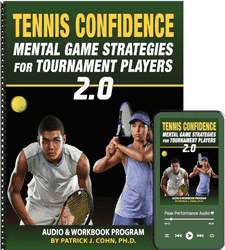
“Tennis Confidence: Mental Game Strategies for Tournament Players” is an audio and workbook program to help tennis players, coaches, and instructors improve the mental game of tennis is just 10 easy to learn sessions. Tennis Confidence: Mental Game Strategies for Tournament Players Audio and Workbook program is ideal for any junior, collegiate, and tour professional player. Tennis coaches and instructors would also be wise to teach the strategies “Tennis Confidence.”
Tennis Confidence is a complete mental training program developed Peak Performance Sports. You learn the same strategies Dr. Cohn teaches his tennis players to help them improve mental toughness and consistency – from managing unrealistic expectations to coping with perfectionism.
Read more about Tennis Confidence Program>>

Dr. Patrick Cohn is a tennis psychology expert with Peak Performance Sportss, LLC. Learn cutting edge mental strategies based on 35+ years of experience in mental performance coaching with professional to junior competitive tennis players. He is the author of The Mental Edge for Tennis 2.0 audio and workbook program.
You made some good points here and the best one was about how you can prove the importance of the mental game by watching pro players.
It’s interesting since you can identify so many mental game errors that either are caused by or are influenced by unforced errors.
Each player’s mental state and toughness is often the deciding factor in pro matches. Especially whenever there is a close match. (great example was S. Williams and Kuznetsova in the Semi.)
Another main problem with trying to teach players the mental game is simply the fact that it is catagorized as “training”. Most players do not find this as “fun” as rallying for the baseline or playing matches. That is probably the reason why many juniors do not want to partake in it.
The problem with trying to get a student or child in the mental game is that although you can present them with reasons why they should do it, it’s ultimately their decision. It’s difficult to force children to do activities that they do not find “fun” or want to do.
The best approach would be to attempt to make all aspects especially “mental training” be fun. That is one of the most important aspects of instructing tennis.