
Trusting Your Training and Skills in Matches
Do you analyze or critique your game each practice session?
Do you look to improve something in your strokes or serve?
Maybe you work on a shot that you just missed in a match?
Do you dwell on the loss, always thinking about things you can do better?
If you lose, do you feel you HAVE to change something in your preparation or performance before your next match?
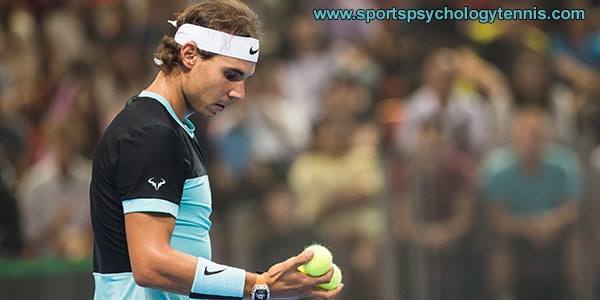
Rafael Nadal recently lost 7-5, 6-3 to Thiem in the Mutua Madrid Open. Nadal was asked what he will do differently to prepare for the next tournament in Rome.
He said after the match:
“I am not super happy when I am winning and not super sad when I am losing. It’s not terrible that I lost the match, and I don’t think I have to do a lot differently to prepare for the next tournament.”
Nadal also stated:
“I won 50 straight sets on this surface. Today I lost the match. It was not my day. But that’s part of this sport… So, I can’t go back to the hotel and think that I have to do a lot of things different to prepare for the next event because it will not be very smart on my part.”
“I can’t think that I’m not doing things well enough. I can’t think I have to do a lot of things different because that wouldn’t be right after all the results I’ve had.”
This loss to Thiem knocked Nadal down to No. 3. He mentioned:
“Of course, I prefer to be No. 1. But right now, I feel fit and have opportunities to compete every single week, and that makes me happy… This my final goal: To be happy. That’s what I’m working on.”
Many tennis players dwell after a loss to a tough opponent, or opponent in general. They might beat themselves up…
You may expect to play a certain way, like win 6-0, 6-0 and have no double-faults. Usually these expectations are unrealistic and can result in you dwelling and being frustrated after a match.
If you dwell, you may also over-analyze after a match and want to change things in your next practice. You might want to do things differently because you think there’s a better way or the reason you lost is due to technique and tactical errors.
Like Nadal, wins and losses are part of this game. Each time you lose you don’t need to go to practice and try to do things completely different or change the way you prepare for a match.
Maybe you need to do the same things–just better.
That wouldn’t be fair to the success you’ve had as a tennis player. When it’s match time, trust yourself, trust your training, and trust the skills you have TODAY.
And if you lose, analyze your game and make a few adjustments if necessary. Like Nadal, be the same after you win and after you lose.
Ray Lewis, the superstar linebacker who played his 17-year professional career with the Baltimore Ravens once said:
“Wins and losses come a dime a dozen. But effort? Nobody can judge that. Because effort is between you and you.”
As a tennis player, you’re going to win and lose. It happens, it’s part of the game.
Don’t judge yourself harshly or dwell after a loss. Rather, reflect on your effort because that’s something you can control.
And remember, trust your training and your skills in your next match. It’s what you’ve got “today”!
Related Tennis Psychology Articles:
- Jankovic: How to Improve After Losses
- Moving on After and Early Round Loss
- Helping Young Tennis Players Manage Losses
- Download our a FREE Tennis Psychology Report
*Subscribe to The Tennis Psychology Podcast on iTunes
*Subscribe to The Tennis Psychology Podcast on Spotify
Improve Your Mental Game for Tennis
Tennis Confidence 2.0

“Tennis Confidence: Mental Game Strategies for Tournament Players” is Dr. Cohn’s program to help tennis players, coaches, and instructors improve the mental game of tennis is just 8 easy to learn sessions. Tennis Confidence: Mental Game Strategies for Tournament Players Audio and Workbook program is ideal for any junior, collegiate, and tour professional player. Tennis coaches and instructors would also be wise to teach the strategies in “Tennis Confidence 2.0.”
Tennis Confidence is a complete mental training program developed Dr. Cohn. You learn the same strategies Dr. Cohn teaches his personal students to help them improve mental toughness and consistency – from managing unrealistic expectations to coping with perfectionism.
Read more about Tennis Confidence Program>>

Dr. Patrick Cohn is a tennis psychology expert with Peak Performance Sportss, LLC. Learn cutting edge mental strategies based on 35+ years of experience in mental performance coaching with professional to junior competitive tennis players. He is the author of The Mental Edge for Tennis 2.0 audio and workbook program.